When Your Child Refuses to Go to School
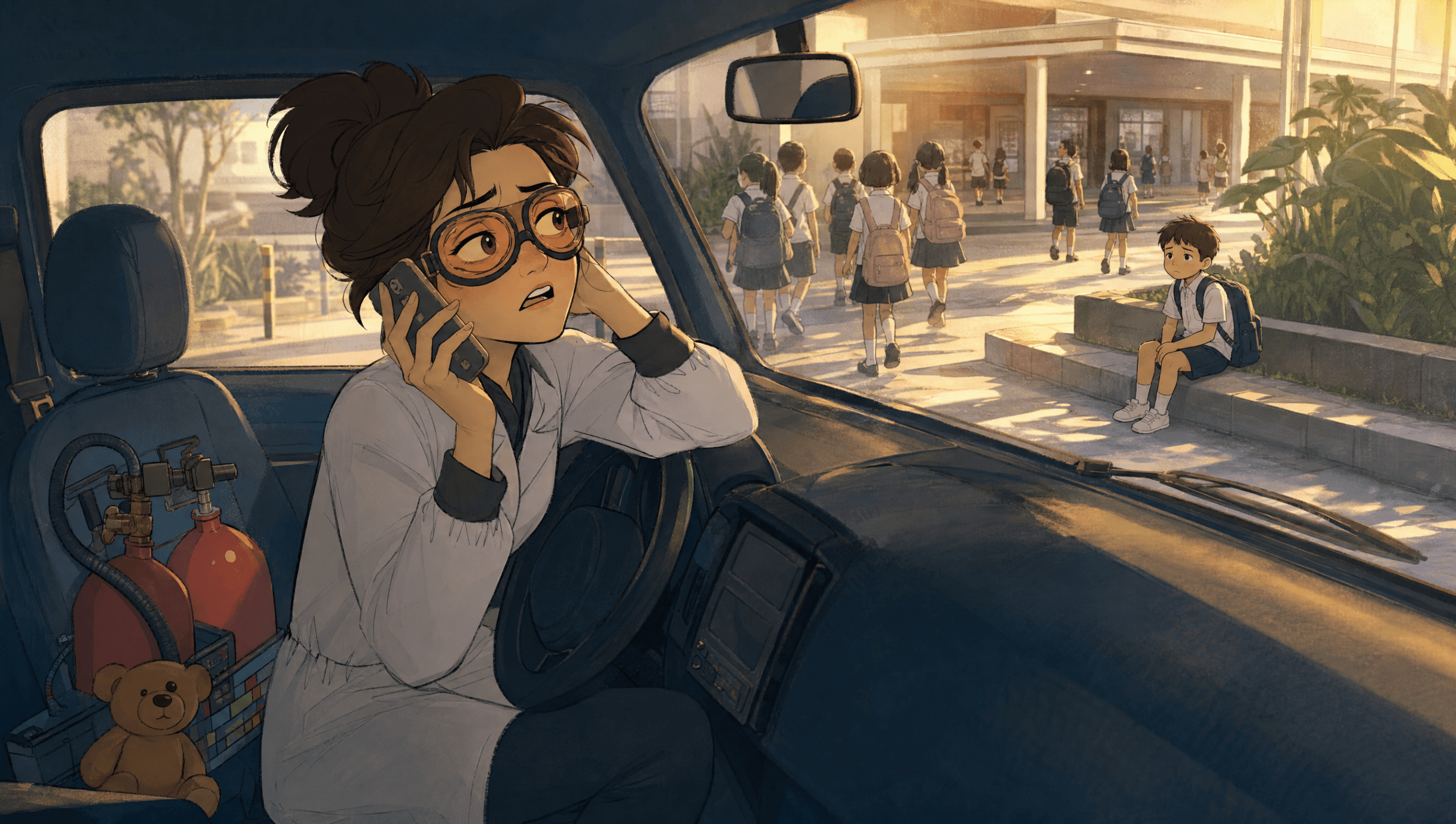
It is barely 8 a.m. and the school nurse is calling me.
"Mrs Lim, J. has a stomachache… again. Can you come and pick him up?"
For months, interminable months, I drove The Youngest One to school every morning, only to receive the same phone call from the school nurse about an hour later.
And so, off I went.
"Mrs Lim, perhaps you should keep him at home when he has a stomachache," the nurse suggested.
But he didn't have a stomachache at home!
The next morning, I would drive him to school again, half expecting the same phone call. And sure enough, I would find myself making another trip to school to bring him home.
Every single day. For months.
Like all moms, the first thing I did was to bring him to general practitioners, then specialists, then a gastroenterologist. Many tests later, nobody could find anything wrong with his stomach.
I went further. I travelled to another and consulted a famous gastroenterologist.
He looked at the test results, then started asking The Youngest One questions about everything else but his stomach.
How was school? Did he like his classmates? How were his teachers? How many tennis matches did he win last season?
Hm… His stomach was fine. But perhaps school wasn't. That was what the gastroenterologist concluded.
The Youngest One was experiencing an increasingly vexing problem many schools and parents face: school refusal.
School refusal is not quite the same as truancy. These children are not necessarily trying to escape school to go out and have fun.
Some become so anxious or distressed about attending school that they develop physical symptoms, some refuse to leave home, or simply cannot stay in the classroom. It happens to some kids for a short period, others for much longer. Some recover quickly, others take years.
And the reasons vary enormously.
Recently, our school have had parents contacting our counsellors for alternative education paths because their children had stopped attending school, sometimes for months, sometimes for years.
One boy had entered one of Singapore's most prestigious schools for gifted Mathematics and Science students. He was under such stress that even his fingers had become stiff, and he could no longer move them properly. By the time his parents sought help, he had refused school for almost two years.
We also encountered children who had been perfectly happy in primary school, but struggled terribly after moving to secondary school. Suddenly, they couldn't relate to their new classmates. The friends, familiarity and sense of belonging they had enjoyed in their childhood were gone.
The problem is not limited to academically overwhelmed kids. In fact, most of those we took in were academically gifted children who were underperforming. Some were bored, some bullied, some lonely, and some simply unable to fit into their existing or new school environment.
And sometimes, as in The Youngest One's case, the reasons are closer to home.
Four of his older siblings were radically accelerated, and for some reason, I had decided I wanted a "normal" child who would progress through the "normal" school system. After four children who had taken rather unconventional educational paths, I thought that was a reasonable idea.
But sending him to school daily and then fetching him home after an hour did not cut it. He did not even make it to the classroom.
After months of trying, I took the nurse's advice: to keep him home, anticipating his stomachaches.
I knew he would fall behind in many areas: social circles, sports, extracurricular activities and academics.
So I devised a plan.
Academically, I simply took out the same education curriculum that had successfully put his four older siblings (and many of our students) into renowned universities. For me, that was the easiest part.
The rest, I looked for solutions by sending him to more tennis classes and getting him involved in other activities outside school.
He went on to ace both his high school examinations and the SAT, entered university at 13 and graduated at 17.
So much for my plan to have one "normal" child!
Of course, not every child who refuses school needs to be accelerated. That is not the point.
My point is that while we are helping these children overcome whatever is troubling them, why should their education stop?
Imagine a child who has missed a year or two of school. Even if he eventually feels ready to return, he may now have so much catching up to do that he faces another formidable problem.
And perhaps another reason to feel inadequate.
At least, by helping him continue learning at his own pace, we can preserve one area of his life where he can experience success and build his self-esteem.
Do you have a child, or know someone whose child, repeatedly complains of stomachaches or headaches or simply cries before school? Has the child become withdrawn, changed his behaviour, or shown increasing distress about attending school?
These may be signs that something is wrong.
Don't be too quick to dismiss them as excuses or laziness. And don't assume physical symptoms are psychological without checking.
Speak to the school. Reach out to psychologists, counsellors or other professionals for help.
And if your child has already stayed home for months or years, unable to face school, perhaps it is time to consider bringing education to him instead.
There are people who have been through this and can help. At least, I know we can.

哈佛大学受训的教育者,曾任新加坡管理大学全职讲师,也是五个孩子的母亲——五个孩子都在 11 至 15 岁之间进入大学。廖秀梅基于一个信念创办了全资优学校:每个孩子都以不同的方式拥有天赋,而教育的使命,就是把每个孩子的潜力发挥到极致。
如果这篇文章引起了您的共鸣……
让您思考方式焕然一新的教育洞察。
加入来自10个国家的家长,每周阅读Pamela关于教育、育儿与培养资优学习者的深度洞察。
无垃圾邮件。可随时退订。我们尊重您的隐私。