When Your Bundle of Joy Says Goodbye at 6
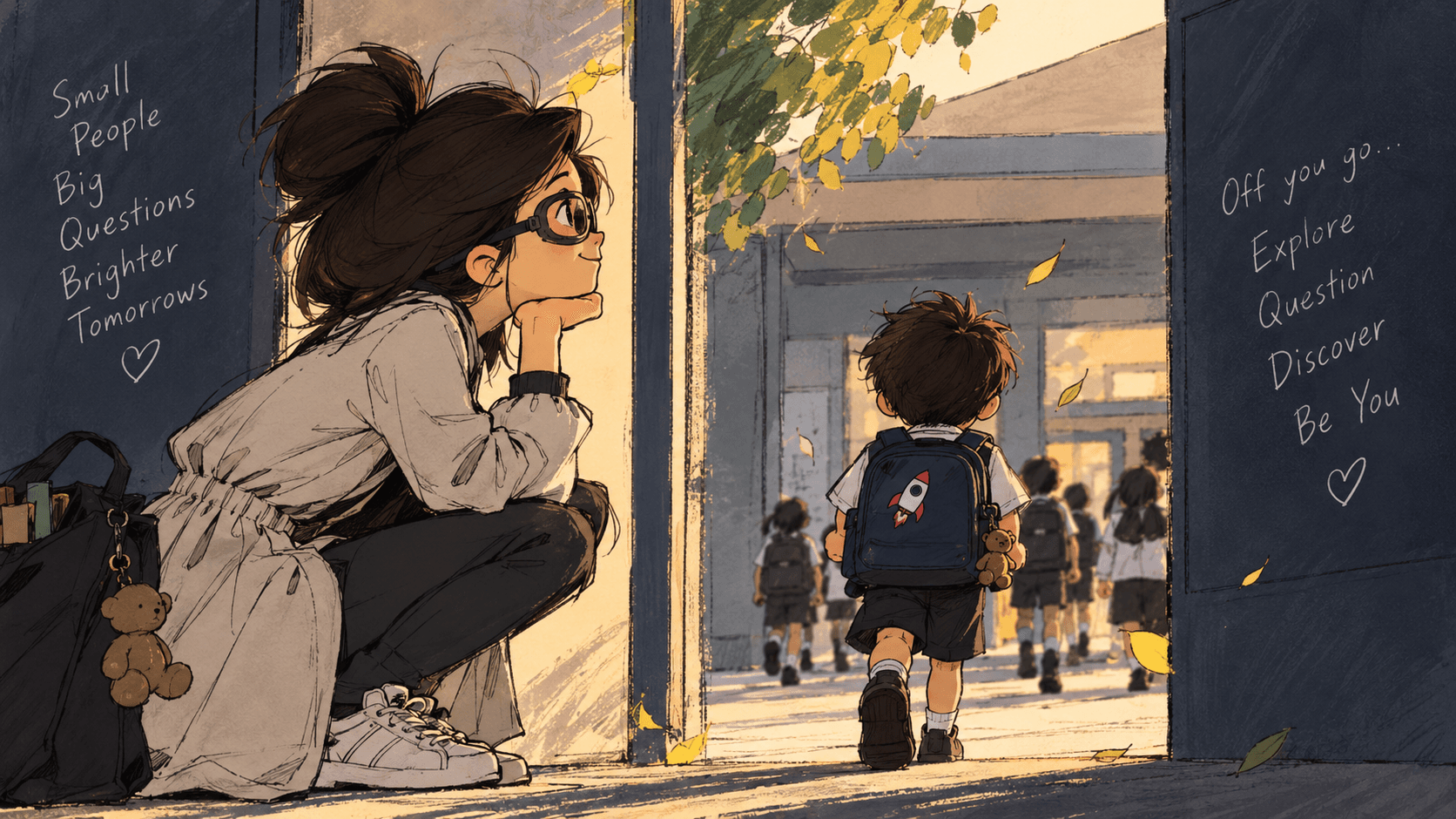
I remember saying goodbye to The Youngest One as he was herded into his primary school when he started formal schooling. I put my boys into the best school I believed I could put them into. One that promised to deliver a gentleman, not just a bookworm.
He could progress from P1 all the way to pre-U, and then go to university to prepare for his passion. I had it all planned out.
But I did not realise that first day of school was the last day I saw that sparkle in his eyes: that enthusiasm, that zest for everything I showed him, the never-ending stupid questions he could think of, the need to sell me every idea he had, and the love for arranging my groceries in my shopping cart at NTUC.
As he was marched away by teachers telling each P1 kid exactly where to queue up to go for their classes, I saw the anxiety in him that broke my heart.
Like many parents, I thought school was giving him a future, but I didn't realise what I was trading away some of my own tradition by teaching him at home.
Of course, I always knew the first six years of a child's life are extraordinary. I teach parenting!
I knew by the age of six, a child's brain has reached approximately 90–95% of its adult size. Brain development in the first 6 years are particularly important for laying foundations.
I brought The Youngest One to Yamaha music classes when he was four, hoping to develop that perfect pitch (it works btw, and no, I am not paid by Yamaha).
Swimming. Archery. Golf. Tennis. And just about everything else I could think of, not expecting to raise a musician, a swimmer, an archer or a professional golfer.
“Just find what you like!”
But his favourite activity seemed to be arranging groceries in my shopping cart, or arranging the shoes his four older siblings had thrown everywhere.
He was only interested in being a good kid, a reliable one. In school, he did the same. Always the first one to turn up in class, always the neatest, always the one who finished his work with the best penmanship.
But when he came home and asked why his teacher didn't agree with him that a square is a rectangle. Hm…
“A square is theoretically a rectangle, but in school, you must not call it a rectangle.”
That was when I realised he would have to grapple with two different worlds. At home, I encouraged him to question, to reason and to trust his own understanding. At school, he was learning that even when he was right, he might still have to give the answer his teacher expected.
A square is a rectangle. Mathematically, he was right.
That was also when I realised that I am not the only person who is going to influence him in his life. His school, his friends and his social circle will have a say in how he looks at the world.
And more interestingly, not only will they change the way he looks at things, they will also make me look at things differently through him.
It took me a few more years to realise that I cannot control the world he grows up in, nor should I. He will discover his own values, form his own opinions and sometimes challenge mine. That day, I wasn't just saying goodbye to my bundle of joy. I was also saying goodbye to my monopoly on influencing him.
I realized I only had six years. Max. Have you?

Harvard-trained educator, former SMU full-time lecturer, and mother of five — all of whom entered university between the ages of 11 and 15. Pamela founded All Gifted School on the conviction that all children are differently gifted, and that education's job is to bring every child's potential to its fullest.
If this resonated with you...
Education insights that make you think differently.
Join parents across 10 countries who read Pamela's weekly insights on education, parenting and raising gifted learners.
No spam. Unsubscribe anytime. We respect your privacy.