A-Levels vs IB vs US Diploma — What Singapore Parents Actually Need to Know
Every year thousands of Singapore parents face the same fork in the road: A-Levels, IB, or something else entirely? Here is what you actually need to know — without the marketing spin.
A-Levels: Deep but Narrow
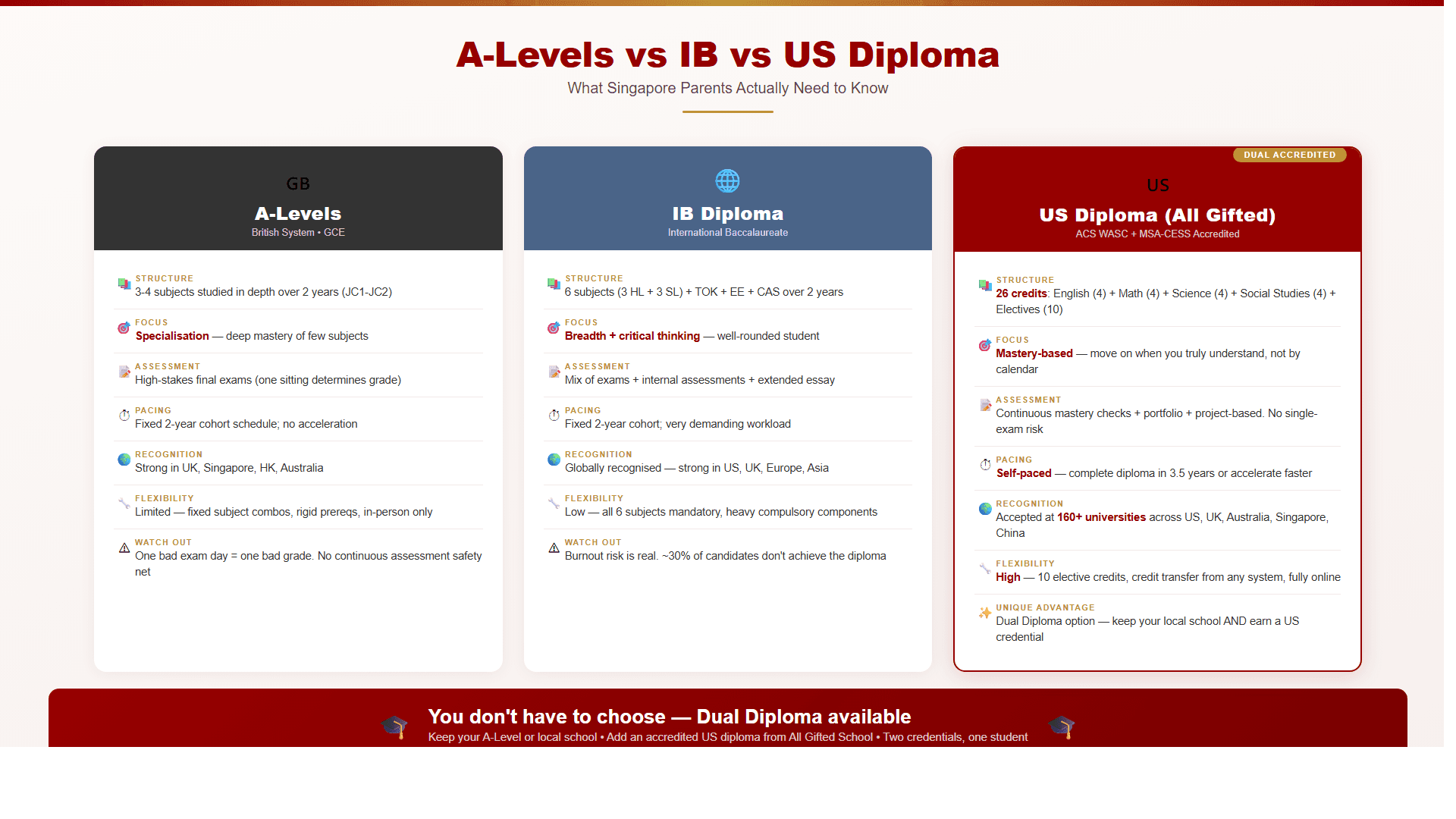
The GCE A-Level system, delivered through Singapore’s Junior Colleges, asks students to specialise early. You pick 3–4 subjects and study them in depth over two years. The payoff is genuine mastery in those subjects. The risk is real: your entire grade rests on a single exam sitting. One bad day, one bad result.
A-Levels are well recognised in the UK, Singapore, Hong Kong, and Australia. But flexibility is limited — fixed subject combinations, rigid prerequisites, and in-person attendance only.
IB Diploma: Broad but Brutal
The International Baccalaureate takes the opposite approach: breadth. Six subjects (three at Higher Level, three at Standard Level), plus Theory of Knowledge, an Extended Essay, and CAS (Creativity, Activity, Service). It produces well-rounded thinkers and is globally recognised.
The catch? The workload is punishing. Around 30% of candidates globally do not achieve the full diploma. Burnout among IB students is well documented. And there is zero flexibility in the programme structure — all six subjects and all compulsory components are mandatory.
US Diploma (All Gifted School): Flexible and Accredited
The US high school diploma system works differently from both A-Levels and IB. At All Gifted School, students complete 26 credits across English (4), Mathematics (4), Science (4), Social Studies (4), and Electives (10). The programme is accredited by both ACS WASC and MSA-CESS — dual accreditation that is recognised worldwide.
Three things set this apart:
- Mastery-based pacing: Students move forward when they genuinely understand, not when the calendar says so. The diploma can be completed in as little as 3.5 years — or faster for students who are ready.
- Continuous assessment: No single high-stakes exam determines your future. Assessment is ongoing through mastery checks, portfolios, and projects.
- Credit transfer: Students coming from any system — A-Levels, IB, IGCSE, local curricula — can transfer existing credits and complete only what remains.
Graduates have been accepted at over 160 universities across the US, UK, Australia, Singapore, and China.
You Don’t Have to Choose
Here is what most parents don’t realise: you do not have to pick one or the other. All Gifted School offers a Dual Diploma option. Your child stays in their current school — JC, international school, or local school — and simultaneously earns an accredited US diploma. Two credentials. One student. No transfer required.
Ten elective credits mean students can pursue what they are genuinely interested in, not just what the syllabus dictates. The entire programme is delivered online, making it accessible from anywhere.
The Real Question
The question is not which system is “best.” The question is which system fits your child — their learning style, their pace, their goals. A child who thrives under exam pressure may do brilliantly in A-Levels. A child who wants breadth and structure may love IB. A child who needs flexibility, mastery-based progression, or a second credential has a clear pathway through All Gifted School.
If you want to explore what fits, visit allgifted.com or contact us to talk it through. No sales pitch — just clarity.
— Pamela Lim, Founder and Director, All Gifted School

Harvard-trained educator, former SMU full-time lecturer, and mother of five — all of whom entered university between the ages of 11 and 15. Pamela founded All Gifted School on the conviction that all children are differently gifted, and that education's job is to bring every child's potential to its fullest.
If this resonated with you...
Education insights that make you think differently.
Join parents across 10 countries who read Pamela's weekly insights on education, parenting and raising gifted learners.
No spam. Unsubscribe anytime. We respect your privacy.